
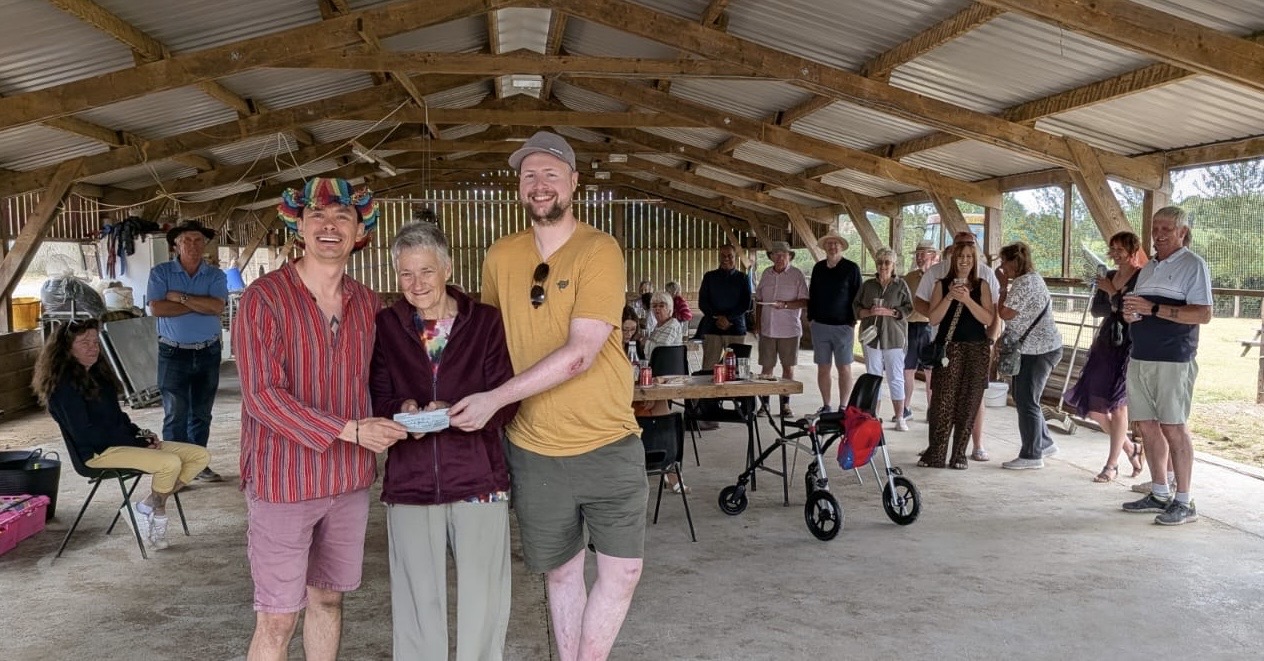
Each year, the charity trustees of Unity Lodge meet to consider where the Lodge might best direct its charitable support. The process is deliberately local in outlook: looking at organisations, projects and groups whose work is making a practical difference to people in the surrounding community.
In June 2026, that annual discussion resulted in donations totalling around £1,800 across eight causes.
That would already have been a worthwhile contribution. But individual members of the Lodge then chose to add donations of their own, increasing the overall amount to just under £4,000.
The result is a pleasingly varied picture of community support — encompassing children with additional needs, young people facing homelessness, unpaid carers, sport, Scouting, suicide bereavement support and even something as simple as a teddy bear placed into the hands of a frightened child in hospital.
Vranch House School and Centre
Exeter’s Vranch House School and Centre supports children and young people with physical difficulties and complex needs.
Vranch House describes its approach as providing a safe, accessible and supportive environment for learning and development, with education working alongside areas such as physiotherapy, communication and sensory support. The school caters for children and young people from the age of two through to 19.
It is the kind of highly specialised provision whose impact extends beyond the classroom, supporting children to communicate, develop independence and participate more fully in everyday life.
Bow School Swimming Pool
Closer to home, Unity Lodge has also supported the swimming pool at Bow Community Primary School.
The school is fortunate to have its own outdoor pool and uses it to provide pupils with regular swimming lessons during the summer term. Its stated aim is that every child should be able to swim 25 metres by the time they leave the school.
Keeping a small community pool operating, however, comes with very real costs. A fundraising campaign reported in 2024 was specifically established to help meet the pool’s maintenance expenses.
Support for a facility such as this may appear modest beside some larger charitable projects, but its value is easy to understand. Swimming is recreation, exercise and, importantly, a life skill.
Pete’s Dragons
Pete’s Dragons provides specialist support to people affected by suicide bereavement.
The charity was founded in 2010 by Alison Jordan following the suicide of her younger brother, Pete. What began as a small fundraising group has developed into an organisation commissioned to provide suicide-bereavement services in Devon and North Somerset.
Its approach recognises that grief following suicide can be particularly complex. Support is tailored to the individual rather than restricted to a fixed number of sessions, and the charity also has specialists working specifically with children and young people across Devon, Plymouth and Torbay.
It is demanding work, often carried out with people at exceptionally difficult points in their lives, and an important part of the support network available within the county.
The Amber Foundation
Another recipient, The Amber Foundation, works with young adults aged 18 to 30 who are homeless or facing complex difficulties.
Amber provides supported accommodation alongside help with employment, personal development, wellbeing and independent living, with the aim of enabling young people to move away from homelessness towards more stable and independent futures.
Its Devon supported-housing centre can accommodate up to 30 young adults at a time.
The value of that work lies not simply in providing somewhere to stay, but in addressing some of the underlying problems that can make it difficult for a young person to establish a secure life of their own.
Devon Carers – Westbank
Devon Carers, delivered by Westbank Community Health and Care, supports the many people across the county who provide unpaid care for a relative, friend or neighbour.
That may mean looking after somebody who has a disability, illness or long-term condition, or an older person who increasingly needs help with everyday life.
Among the services available are information and advice, training and peer-support groups, giving carers opportunities to meet others who understand the particular pressures that caring can bring. Westbank has highlighted the additional challenge of reaching carers in Devon’s rural communities, where isolation and limited transport can make an already demanding role still harder.
Unpaid carers can easily become invisible precisely because so much of what they do takes place quietly at home. Supporting those who support others is therefore a particularly appropriate part of community charitable giving.
Scouts bound for the Faroe Islands
Unity Lodge also contributed towards a Scouting expedition to the Faroe Islands.
Mid Devon Scouts’ Nordic Experience 2026 includes an Explorer Belt expedition to the Faroes for Explorers and Scout Network members aged 16 to 24. The Explorer Belt is intended to be a genuine expedition rather than simply a trip abroad, requiring participants to plan, travel and work together in an unfamiliar environment.
Opportunities of that sort can be formative for young people, developing independence, teamwork and confidence — but international expeditions are inevitably expensive. Mid Devon Scouts estimated the typical cost of its Explorer Belt expeditions at around £1,200 to £1,500 per participant, making fundraising an important part of getting there.
Supporting local young people to take part therefore represents an investment not only in an expedition, but in an experience they are likely to remember for many years.
Crediton Rugby Club
Crediton Rugby Football Club was another of this year’s recipients.
Founded in 1878, the club today fields rugby across a remarkably broad age range, including senior men’s and women’s sides, veterans, Colts and numerous boys’ and girls’ age-group teams.
Its junior section alone had around 11 teams during the 2025/26 season.
Community sports clubs rely heavily upon volunteers, facilities and the steady work required to provide organised sport week after week. Their contribution is not confined to results on a Saturday afternoon: they provide somewhere for people to belong, volunteer, develop skills and form friendships across generations.
Teddies for Loving Care
The final beneficiary is one with particularly strong links to Freemasonry: Teddies for Loving Care, usually known simply as TLC.
The idea is beautifully uncomplicated. Small teddy bears are supplied to hospital departments so that medical staff can give them to children who are frightened or distressed. They may provide reassurance, reward bravery, serve as a distraction during treatment or even help staff demonstrate a procedure.
In Devonshire, the TLC scheme began in 2008, initially supplying Torbay Hospital before expanding to the Royal Devon and Exeter Hospital, Derriford Hospital in Plymouth and North Devon District Hospital, as well as Little Bridge House Children’s Hospice.
It is a small intervention in material terms, but anybody who has accompanied a frightened child into hospital will readily understand why the comfort it provides can matter.
Local giving in many different forms
There is no single theme linking all eight beneficiaries, and perhaps that is the strongest feature of Unity Lodge’s 2026 charitable giving.
One donation helps a child learn to swim. Another supports specialist education. Others help a bereaved family, an unpaid carer or a young adult trying to move beyond homelessness. One helps young Scouts travel beyond their normal horizons; another supports generations of people taking part in their local rugby club. Somewhere else, a teddy bear may make a hospital visit just a little less frightening.
The Lodge trustees initially allocated around £1,800. Through the generosity of individual brethren who chose to add their own contributions, that figure grew to almost £4,000.
There is nothing complicated about the principle behind it. Freemasonry’s charitable work is at its best when it notices the useful work already being done by people and organisations within our communities and helps them to do a little more of it.
For Unity Lodge in 2026, eight very different causes provided eight good reasons to do exactly that.